


Article: How to Make Your House Smell Like a 5-Star Hotel (Without Spending a Fortune)

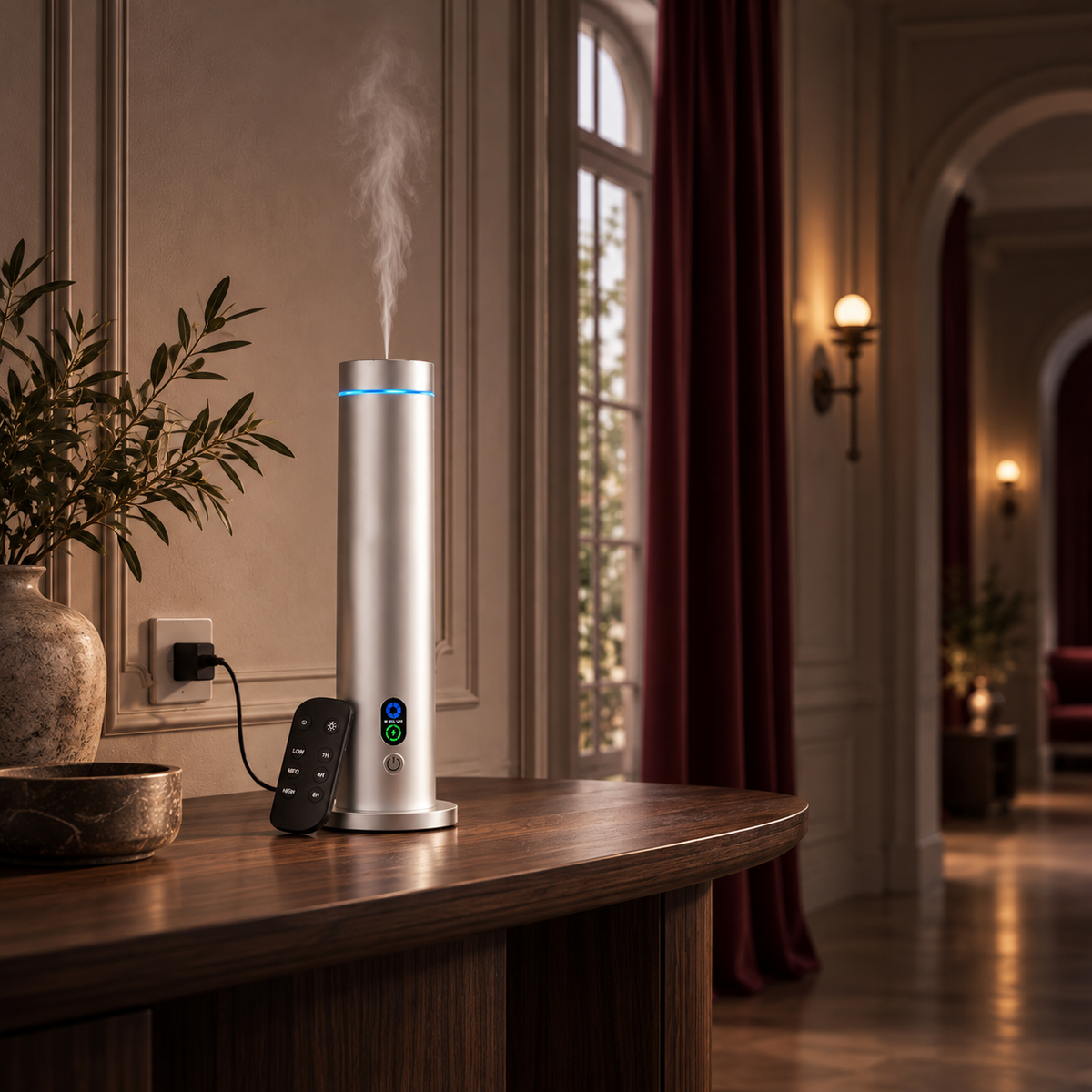
How to Make Your House Smell Like a 5-Star Hotel (Without Spending a Fortune)
You know it the second the doors slide open.
Something clean but warm. A little woody, a little sweet, never sharp. It doesn't smell like air freshener — it smells like somewhere. Within ten seconds you're standing up straighter, breathing deeper, already half-decided you're staying another night.
That feeling is not an accident, and it's not a $400-a-night perk. Hotel scenting is a system: a specific fragrance family, delivered by a specific type of diffuser, at a specific intensity, placed in a specific spot. Every one of those four variables is something you can copy at home for the price of a nice dinner out.
Here's how, in the order that actually matters.
Why Do Hotels Smell So Good? (It's Not Just the Fragrance)
Hotels don't just pick a scent they like. They engineer one — and they do it for reasons that have nothing to do with luxury and everything to do with psychology.
1. Smell is processed next to memory and emotion. Your olfactory bulb wires almost directly into the limbic system, which is why a scent can put you back in a place faster than a photograph can. Hotels are effectively renting space in your memory: the lobby smell becomes the memory of the trip.
2. Scent masks the things a building can't hide. Hundreds of guests, cleaning products, carpet, recycled air. A consistent ambient fragrance is cheaper than perfect ventilation.
3. Consistency is the whole trick. A hotel lobby never smells "freshly sprayed." It smells continuously the same — the same note at 7 a.m. and at 11 p.m. That steadiness is what your brain reads as quality. Spray air fresheners spike and fade; a hotel's scent never leaves.
That last point is the single most useful thing to steal. Most homes fail not because they chose the wrong scent, but because the delivery is intermittent. One candle at night, one spray when guests come over, nothing in between.
What Does a Hotel Lobby Actually Smell Like?
Strip away the branding and almost every five-star lobby scent is built from the same six notes. Learn to recognize them and you can shop by note instead of by marketing.
| Note | What it adds | Where you'll recognize it |
|---|---|---|
| White tea | Clean, airy, faintly sweet | Westin, spa lobbies |
| Cedar / sandalwood | Warm structure, "expensive wood" | Ritz-Carlton, Four Seasons |
| Bergamot / lemon | Brightness without sugar | Ritz-Carlton, Shangri-La |
| Fig | Green, milky, modern | 1 Hotel, boutique properties |
| Amber / musk | Skin-like warmth, staying power | Almost all of them |
| Jasmine / lily | Soft floral lift | Mandarin Oriental |
The winning formula most hotels land on is roughly 60% clean (tea, citrus) + 30% warm wood (cedar, sandalwood) + 10% soft floral or amber. That ratio is why the result reads as "clean but luxurious" instead of "candle shop."
Never let one note dominate. If it smells like a single thing — pure vanilla, pure lemon — you've left hotel territory.
Step 1: Get the Delivery Right (This Matters More Than the Scent)
You can buy the perfect hotel-inspired oil and still get a house that smells like a bathroom. The diffuser decides whether the fragrance behaves like hotel air or like a room spray.
| Method | Consistency | Coverage | Upkeep | Verdict for hotel effect |
|---|---|---|---|---|
| Cold-air / waterless diffuser | Excellent — continuous, adjustable | Large (up to 1,000+ sq ft) | Refill oil every few weeks | The closest match. This is what hotels actually use. |
| Plug-in wall diffuser | Very good — runs silently 24/7 | Medium (one room) | Swap oil bottle monthly | Best value. Same principle, a fraction of the price. |
| Ultrasonic (water) diffuser | Good but dilute | Small–medium | Daily water, weekly cleaning | Fine for a bedroom; scent gets watery in big rooms. |
| Reed diffuser | Low and steady | Small | Flip reeds weekly | Good for bathrooms and hallways, too weak for a living room. |
| Candle | Poor — only while lit | Small | Trim wick, replace often | Great for atmosphere, bad for continuous scent. |
| Spray | Worst — spikes and dies | Immediate only | Constant re-spray | This is the thing that makes homes smell like a hotel bathroom. |
The rule: if you want people to say "your house always smells amazing," you need something that runs without you. That means cold-air, waterless, or plug-in — not flames, not spray.
A wall-mounted plug-in is the smart entry point: no water, no heat, no wick, no cleaning, and it holds a steady output all day. Set it and forget it is exactly the behavior a hotel lobby is built on.
Step 2: Pick a Scent Profile, Then Match It to the Room
Don't scent the whole house with one fragrance. Hotels don't, either — the lobby, corridor, and suite are deliberately different.
Entryway / hallway — "the first ten seconds." This is the only room where you're allowed to be a little bold. Go citrus-forward with a wood base: bergamot, lemon, cedar. It reads as clean and immediately signals "somewhere nice." This is the spot for your strongest diffuser.
Living room — "the lobby." White tea, fig, soft musk. Clean and elevated, never gourmand — you'll be sitting in it for hours and sweetness turns cloying fast.
Bedroom — "the suite." Lower intensity, warmer notes: sandalwood, amber, lavender, a whisper of vanilla. Run it on the lowest setting or on a schedule that stops before you sleep. Hotel bedrooms are the quietest scented rooms in the building, and that's why they feel calm.
Bathroom — "the spa." Eucalyptus, sea salt, aloe. A reed diffuser is genuinely enough here; small space, occasional use, no electricity needed.
Home office — "the lounge." Something green and clarifying: fig leaf, mint, light citrus. Avoid heavy amber — it's soporific when you need to focus.
Step 3: Placement and Intensity (Where Most People Get It Wrong)
Three rules, learned the hard way:
1. Height beats corner. Scent rises and drifts. Put the diffuser at chest height or above, on a console, shelf, or wall outlet — not on the floor behind the sofa. A wall plug-in is already at the ideal height by default, which is 90% of why it works so well.
2. Never point it at a face. Don't place a diffuser where someone sits or sleeps within three feet of the outlet. You want ambient, not a stream. Two meters of distance is the difference between "what is that lovely smell" and "I have a headache."
3. One room, one source. Two diffusers in one open-plan space fight each other and the result smells like a department store. If your living room and kitchen share air, scent the living-room side only.
On intensity: start low, live with it for three days, then adjust. Your nose adapts within about 15 minutes (that's olfactory fatigue, not the diffuser failing), so judging by "how strong does it smell right now" always leads to over-scenting. Guests will tell you the truth. Your own nose won't.
Step 4: The Layering Trick Hotels Use (Cheap, High Impact)
Fragrance in the air is only half the effect. The other half is the surfaces — and this is where you can beat a hotel on budget:
- Linen: a few drops of fragrance oil on a cotton pad tucked in a drawer, or a hotel-inspired linen spray on pillowcases. One light pass, never a soak.
- Textiles carry scent longer than air. Curtains, throws, upholstery. A single spray on the back of a sofa cushion lasts days.
- The entry ritual: a small dish of oil or a reed diffuser right inside the front door. It's the single highest-leverage placement in any home — first impression, every single time.
- Fresh air first. No diffuser fixes stale air. Two minutes of ventilation before you scent a room is worth more than doubling the output.
What It Actually Costs
| Approach | Upfront | Monthly | Hotel feeling |
|---|---|---|---|
| Candle + spray (what most people do) | $30–60 | $20–40 | 3/10 — intermittent, smells like a home store |
| Ultrasonic + essential oils | $40–70 | $15–25 | 5/10 — pleasant but watery and short-lived |
| Plug-in wall diffuser + hotel-style oil | $50–90 | $12–20 | 8/10 — continuous, room-filling, zero effort |
| Cold-air / waterless machine | $150–300 | $25–40 | 9–10/10 — the real hotel setup |
The plug-in route is the sweet spot: hotel-grade consistency for roughly the cost of two candles a month, and no cleaning, no flames, no water.
7-Day Plan to Get There
Day 1 — Clear the baseline. Wash sofa covers or vacuum upholstery, take out recycling, air the rooms for 10 minutes. You can't layer fragrance over a smell.
Day 2 — Choose one profile. Pick one "clean + wood" fragrance for the main living space. Resist the urge to buy three.
Day 3 — Install at height. Wall outlet or chest-height shelf, in the entry or the room you use most. Not a corner, not the floor.
Day 4 — Set the lowest effective output. Live with it a full day before touching the dial.
Day 5 — Add the textile layer. One light spray on a throw or cushion, one cotton pad in a drawer.
Day 6 — Do the entryway. This is the room guests judge first and the one most people forget.
Day 7 — Ask someone. "Does it smell like a hotel in here?" Their answer, not yours, is the data point.
Four Mistakes That Kill the Effect
- Scenting everything. Six fragrances across four rooms = a candle shop, not a hotel. One coherent profile, varied by intensity.
- Going too sweet. Vanilla-heavy gourmand reads as bakery. Keep sweetness at 10%.
- Chasing intensity. Hotel lobbies are not strong. They're constant. Turn it down and leave it on.
- Ignoring the air. A diffuser in a room with no ventilation just concentrates stale air. Open a window; the scent will travel further.
Frequently Asked Questions
How can I make my house smell like a hotel cheaply? Skip the candle-and-spray routine (about $40/month and inconsistent) and use a plug-in wall diffuser with a hotel-style fragrance oil — roughly $12–20 a month, continuous output, no upkeep. Place it at chest height in your entryway.
What scent do 5-star hotels use? Most signature lobby scents are built from white tea, cedar or sandalwood, bergamot, fig, and a soft amber or musk base. The common ratio is about 60% clean notes, 30% warm wood, 10% floral or amber.
Do hotels use candles or diffusers? Diffusers — almost always cold-air or HVAC-integrated systems, never candles (fire code) and never sprays. The technology exists to keep the scent constant rather than strong.
How long does it take for a room to smell like a hotel? With a cold-air or plug-in diffuser, 20–40 minutes for a medium room. Full-strength perception takes about a day, because your nose needs to stop filtering it out before you can judge it.
Why can't I smell my diffuser anymore? Olfactory fatigue — your brain stops registering a constant scent within 15–20 minutes. It's still working. Confirm with a guest or by stepping outside for a few minutes.
Is a wall diffuser safe around pets and kids? Plug-in diffusers are flame-free and heat-free, which removes the two biggest household risks. Keep oils and bottles out of reach, and use pet-safe fragrance oils if you have cats — avoid high-phenol oils like tea tree, eucalyptus, and citrus in concentrated form.
The Short Version
A five-star lobby is not expensive air. It's one clean-wood fragrance, delivered continuously, at moderate intensity, from chest height, starting at the front door. Get those five things right and the "hotel feeling" is yours for less than the price of a scented candle habit.
Start with the entryway. It's the cheapest upgrade with the biggest payoff — and it's the one your guests will comment on before they've taken their coat off.
Ready to stop guessing?
Shop hotel-inspired scent diffusers → Find your fragrance: white tea, cedar & fig →
Free shipping on orders over $50. 30-day scent guarantee — if it doesn't smell like the lobby, send it back.